|
Home - The Village Today - History - Maps - Memories - Newspapers - Picture Gallery - World Wars |
|
Home - The Village Today - History - Maps - Memories - Newspapers - Picture Gallery - World Wars |
Activities
No television at, first, or electronic games then but one of the ways you kept amused was by listening to the wireless as we called it then. The streets were empty when ITMA was being broadcast. Tommy Handley the star of the show died early and brought that to an end. There were two BBC stations, The Light Programme and the Home Service. Radio Luxembourg was also available, but reception was usually poor. It played popular music and at 7.00 p.m. there was an episode of ‘Dick Barton: Special Agent’ which was very popular. The radios (wirelesses) then needed two batteries, one the high tension battery was a large cardboard covered one which lasted a long time and powered the sound part of the set, the other (the accumulator) was lead acid battery in a glass container which powered the valves and needed regular recharging. This was done by Ted Bramley who used to collect one and deliver one either weekly or fortnightly and drove one of the cars regularly seen in the village. When television arrived it was common for children to go to one of the growing number of houses with a set and ask to be allowed to see ‘Children’s’ Hour’. I was too old to do this, but I remember walking across the fields to Stanley Common to see television for the first time on a 9 inch black and white set. As children, all year round, weather permitting, we played out till bedtime. A lot of my friend’s and my time was spent in the fields and the woods. Apart from Shipley Wood and fields growing crops including mowing grass we felt free to go wherever we wanted. We had catapults made from ¼ inch square rubber strips and a shoe tongue for a pouch. The search for a suitable ‘Y’ shaped stick from the hedgerow was often a long process. Also popular were spears and bows and arrows from hazel. There was a stand of hazel in one of the woods that had obviously been coppiced in earlier times and where, in season, we tightened our belts and filled our shirt fronts with nuts and then sat and broke them open with or teeth despite the warnings of damage given by our parents. There were also chestnut trees but they only gave nuts big enough to eat after a hot summer. We also made dens and generally passed our time. We seldom went bird nesting feeling that it was wrong. We never managed to catch anything with our weapons. One skill we learned was to make a smokeless fire in the woods so as not to give ourselves away. 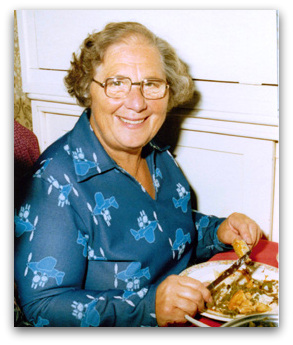 Mabel Martin In the summer on the Mapperley side of the pond and near to the cow drinks when the water level was down there was a piece of dry clay land, which we called the Island sticking out into the pond from where we used to fish for perch using a cane, thread and a bent pin for a hook with worms for bait. We always had one eye on the pond house for Tommy Watchorn who would sometimes chase us off. The fishing rights were held by a small group of men who sometimes used to take a boat out of the boathouse by the house and fish from that. After the N.C.B. took over the estate I had a licence and with friends or my dad spent many happy hours fishing. Before the war the largest carp caught in England was caught in the pond; it is now stuffed and displayed in Wollaton Hall. The record, now, is more that twice as large. At the top end of the pond there are the sides of a bridge which used to carry a road, now gone, and beyond was a small shallow pond, now silted up, where the carp used to spend the night. One evening when I was fishing alone two men, one of whom I believe was Richard Walker, a well known carp fishermen who at that time held the record for the largest carp caught, arrived, they were annoyed to see me there but after we had seen two very large carp swim through and as I was leaving they congratulated on my quietness and calmness. This I valued greatly especially from him. We had various crazes from time to time one of which was kite flying usually from the top of the Meadow (the field at the top of the twitchell) We mostly had home made kites flown with a bobbin of cotton thread. The kites could be made on site, you sliced a strip of wood from the field fence rail, turned and took a long shoot from “Nut” Beardsley’s privet hedge, surprisingly for a keen gardener it always seemed to need cutting, fortunately for us, the leaves were stripped off and the middle of the shoot tied to one end of the strip. Thread was tied to one end of the shoot and passed under the other end of the strip and pulled and tied to the free end of the shoot forming a kite shape with a rounded top and pointed bottom. The kite was covered with (news) paper stuck with flour and water paste and the kite fitted with tailings of grass bunches. Tailings were quite a science; the weight and length affected the performance to a surprising degree. Although we didn’t have the manoeuvrability of the modern two handed kites we had fun with them, for example by fastening a bent piece of wire to the string 3 feet or so below the kite we could send a handkerchief parachute up on another piece of bent wire along the string which would be released by the wire and float down to earth. I also had a spell of making and flying model aeroplanes from balsa wood and tissue paper. In the winter we would make winter warmers; a tin with holes in the side and bottom and a long wire handle. Filled with burning coal it could be stirred into life by whirling it round. 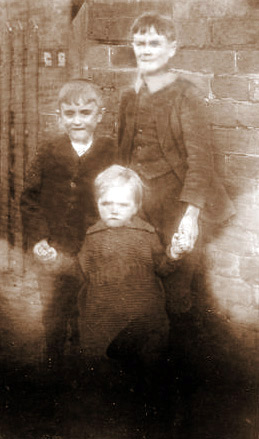 From top Ron, Joe and Fred Martin In season we would do a bit of scrumping from Hill’s orchard, it being remote from the house and easy to get into from the ‘Meadow’. For indoor activities, as well as the wireless, we played cards and board games. I also remember that tiddlywinks was popular in our house for a good while. My dad liked it so much that he once said “The man who invented tiddlywinks must have been a good sort”. We also did things like cutting up old clothes into strips and making peg rugs with the strips. Designing and drawing a pattern on the sacking was a very serious business. Of course, particularly for the men there was the Black Horse. Church And Chapel Most people in the village at that time were to a greater or lesser extent ‘Church’ or ‘Chapel’ During my early years the vicar of Holy Trinity Church was Mr Swain who had a son Robin, some years older than me but I remember once going in to the vicarage when very young to find to my amazement that he had his own room and that there were two flights of stairs. Mr Vaughan followed, coming from Lancashire, was it Widnes? When there, his Church outings had been to Southport which was relatively near to his old parish, so we had a couple to the same place, a much longer trip! Especially on Felix buses which were renowned for going slowly. There is a group ‘photo on this web site of one of the trips. I remember Sunday school in the afternoons. At one time the organ needed pumping and a trick the boy who used to pump it told me was to let the indicator get right down to nearly empty and then pump like mad making the organ roar out. This trick had to be used sparingly! Later when the organ became too expensive to repair an organ with a treadle was situated at the front of the nave and it was great sport to watch the seat sway from side to side while the organ was being played and wonder when it was going to collapse. It never did! After Mr Vaughan left Mapperley ceased to be an independent parish and the vicar was Mr Spencer also of West Hallam. The church became unsafe due to mining subsidence and was demolished and while the present building was being erected a temporary wooden building situated at the top of the field called Cow Flat, at the end of Church Lane was used. The Methodist Chapel, situated below the semis at the top of Lodge Row, was very active with quite a few of the people in the congregation coming from West Hallam which had no chapel of its own. At one time, on the balcony, a club for the children was run by The Sons of Temperance, where we first had to take an oath not to touch alcohol, we did so, probably thinking that we would keep it. The organisation gave people the opportunity to pay a few pence a week to cover medical expenses in the pre N.H.S. days, it carried on for a while after the start of the N.H.S. and paid out to people when sick but the amounts were small and it gradually faded away. The chapel always put on a better show than the church in their annual Anniversaries with the children on a raised stage singing and reciting and always very smartly dressed.
The man on the extreme left of the photo is my Dad, Ron Martin School

Disclaimer - Copyright - Is this page correct? Something wrong or missing? Please let me know. Also contributions very welcome |



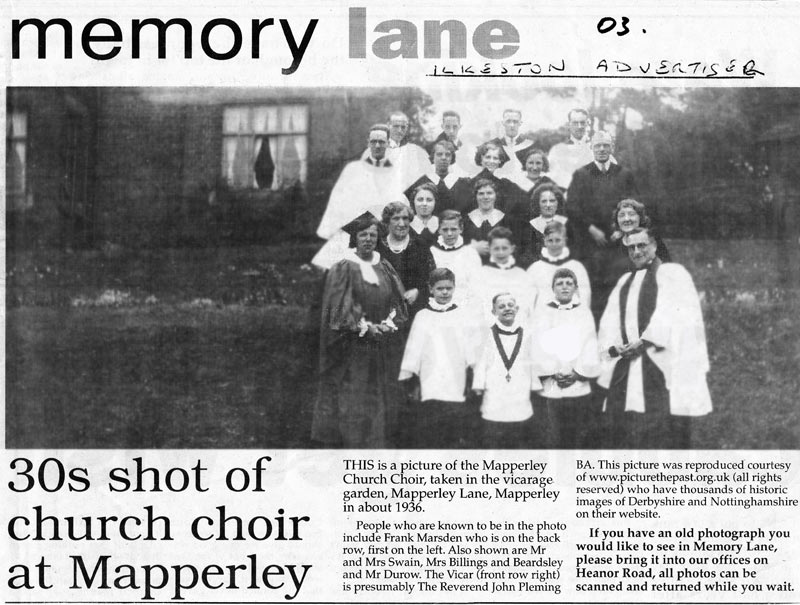
 My first day at school was eventful. I was keen to learn to read and write and after the first morning went home disillusioned as we had only played at our little tables. I went home for lunch and was surprised to learn that I had to go back in the afternoon. I was put through the gate by my mother and aunt and promptly ran to the other gate which was never used and tried climb over it to run away. After being put through the gate a couple of times with the same result the vicar; in those days a highly respected, slightly remote, man tried to stop me from climbing over and, 'Shock Horror', I hit him with my gas mask which I had in my mother's patent leather, shoulder gas mask bag instead of the issue cardboard and string carrier.