|
Home - The Village Today - History - Maps - Memories - Newspapers - Picture Gallery - World Wars |
|
Home - The Village Today - History - Maps - Memories - Newspapers - Picture Gallery - World Wars |
|
Stanley Stanley Parish and Area History (Page 2) by Terry Hall 2000 Speculation, maybe, but portions of the structure incorporated in the Church at Stanley, were built at approximately the same period as the enlargement to Spondon Church. The old Stanley Church Magazine covers carried a photograph of Stanley Church, and alongside were the words "Rebuilt AD 1200, Restored AD 1876". It is accepted the Church is built on the site of a former Saxon Church, but no trace of Saxon work is visible in the present structure, the oldest portions being of Norman origin. During the Restoration and enlargement of the Church in AD 1876, the Chancel was extended, the present Chancel Arch being in the position of the former East Wall. At the same time the old East window was moved into its present position. There is an old photograph of the Church, prior to the Restoration, in the Vestry.
The carved oak pulpit is of the Jacobean period. According to a report of the "Ilkeston Pioneer" of December, 1905, the pulpit had been "painted and varnished so many times over and nailed that the oak and carving were quite obliterated, and the value of the pulpit quite unrecognisable, except by experts". The vicar at that time, the Rev. H.L. Day, consulted the Chairman of the Church Crafts Guild resulting in restoration by a Mr. MacBeth of Derby, to the effect that the pulpit is probably one of the best specimens of Jacobean work in the Diocese. Originally at the foot of the pulpit was the only ancient monument in the Church, a tombstone with inlet brass plate bearing the following inscription: "Here lyeth the body of Sir John Bentley, when he lived of the Priory of Breadsall Park, uppon his right hand lyeth his Mother and on his left hand Charles ye sone and heire of Gervas Cutler Esq by Elizabeth his wife, the Younger daughter of the said Sir John, which Sir John departed this life on the 1st day of Feb. 1621 anno actates sue 67". The plate is now fitted on the north wall near the pulpit. All enquires fail to find the reason this family were buried at Stanley Church, but my interest was aroused when renovations were being carried out in the Church during the Autumn of 1950, when it was found necessary to remove the whole of the seating accommodation and flooring on the north side of the Church. When assisting with this work an enlightening discovery was made. The removal of the flooring revealed an aperture beneath the Sir John Bentley memorial plate, but unfortunately not of sufficient depth to allow an unrestricted view. However, by the aid of a torch it was possible to discern tombstones that had been placed face downwards. Only the fluted edge of the stones were visible, but by placing the fingers underneath lettering could be felt. There is no mention in the Church Registers dating from 1671. The Royal Coat of Arms at the west end of the Church is well worth mentioning. During 1964, the Vicar, the Rev. B.G. Fell, MA, was responsible for arranging the expert cleaning and restoration of this work, the cost being covered by an anonymous parishioner. This revealed colours and details previously covered by the grime of ages and posed a problem for the experts. The work appears to have been painted on old cart boards. Although there are some slight discrepancies due to previous restoration, for example a wrong metal chain for the Nassua Shield, the Coat of Arms is now accepted to be that of William the Third. The following information is now given below the work - "The above Arms are those of William 111 of England, also William of Ornage, and must date from his reign. This period is indicated by the inclusion of his personal Arms, those of the House of Nassua. The Arms also contain the Three Lions of England, the Fleur de Lys of France, the Standing Lion of Scotland, and the Harp of Ireland. This is rare version of Royal Arms, and very few remain intact". The two bells in the turret above the Royal Arms were re-cast by Messrs. Taylor Bros, of Loughborough in the 1920's. Prior to being recast they bore the inscription "William Darteshar 1661, Richard Briggs 1661". The stained glass window memorials to former landowners and benefactors of the Church and Parish include three to the Canner Family. That in the east window is dedicated "To the Glory of God and in memory of Edwin Canner JP, for many years Churchwarden of this Parish, who passed away 28th May 1905 aged 68 years, this window is dedicated". That in the Early English light, sometimes wrongly described as a squint window, is "In memory of John Canner who died Dec 1858". This gentleman was Churchwarden when Stanley became a Perpetual Curacy in 1852.
The pictures of SS. Paul and John in the window in the south wall are "To the Glory of God and in memory of Robert Evans, who died Jan 29th 1864". In the north wall is found "This window was erected by F.H. Bateman to the Glory of God and in loving memory of her husband T O. Bateman at rest Jan 14th 1874". Members of the Canner family and the Evans family, along with the late W.D.N. Drury Lowe Esq., of Locko Park, were the donors of the land upon which both Stanley and Stanley Common Church of England Schools were built. Other memorials on the walls include a brass plate "To the memory of Alfred Augustus Gibson, 15 years incumbent of this Church, who died Nov 19th 1866. Also to Caroline Charlotte, wife of the above, who died May 19th 1902" This gentleman was the first Vicar of Stanley. Another plate reads, "In affectionate memory of the Rev John Godson, Vicar of this Parish 1871-79. Born March 8th 1829. Died March 1st 1896 at Ashton Hayes Vicarage, Cheshire". This gentleman was responsible for the restoration and enlargement of the Church in 1875. Another plate reads "In memory of Richard Hart, for 23 years Clerk of Stanley Church, Died July 15th 1897, Aged 72 years". Another is "To the Glory of God, and in loving memory of William Durow, First Class Boy who lost his life in the sinking of HMS Formidable, Jan 1st 1915 aged 18 years. RIP". Marble tablets on the walls record "Near this place lie the remains of Rachel Radford, wife of John Radford, Gent who died 13th September 1779, also the remains of the said John Radford of this place who died 18th April 1788 aged 75". This family name is the oldest readable on a tombstone in the Churchyard, which is dated 1733. Another tablet reads "Beneath this place lie the earthly remains of Joseph Coxon, Farmer, formerly of Atlow Mott, in this County, who died May 31st 1829 aged 84. Also Elizabeth his wife who died May 27th 1836 aged 83. This tablet was erected in grateful remembrance by their son Thomas Coxon".
Of some of the Church furniture forming more recent memorials are The Altar, The Lectern, and the Priest's Prayer Desk. The Altar is dedicated "To the glory of God and in memory of Thomas and Hannah Outram. This Altar was given by their daughter Edith Jane Outram, 1950." The Priest's Prayer Desk is dedicated "To the Glory of God and in sacred memory of Thomas, 1888-1954 and Louisa Hartshome 1894-1960". The Lectern bears the inscription "In memory of Arthur Stanley Bacon 1875-1962, Head Master of Stanley St. Andrews School 1915-1939. Given by his pupils and friends". The Porch and Screen were erected by the Rev. E.F. Schofield, MA, during his incumbency. The Porch was dedicated as a War Memorial to those of Stanley who lost their lives in the First World War. The tablet in the Porch reads "This Porch was erected To the Glory of God in Loving Memory of Robert Costall, Samuel Holloway, Arnold Davis, Joseph William James, Thomas Davis, George Hamilton Morgan, William Durrow, Roland Sigley who gave their lives in the Great War 1914-18. R.I.P. Now let us take a peep into the Church Registers. The first entry of a burial makes interesting reading. It states "1678 Will Eringham ye sonne of John Eringham of Standly and Margaret his wife obit Sep ye 26th", and alongside is written "affid: made within eight days after he was buried onely in woollen according to ye Act of Parliament". The Act came into force in King Charles II reign in 1666 with the intention of encouraging the woollen industry and also prevent money going out of the country for the purchase of linen. The Act was repealed in 1814. In 1690 an entry was made thus "Richard Bagshaw aged 100 + 2 was buried Decemb ye 12". Another in 1694 reads "Mr Leison having resigned this Church to go to Normanton 1 Stephen Gronett Vickar of Ockbrook in ye vacancy of ye Church have baptised Dorothy Hambleton ye 22nd Oct. Borne ye 22 of Sept". Daniel Leeson was Vicar of Spondon from January 25th 1674, to 1694. In 1712 an entry appears "Joseph Milns his wife and daughter falling into the coal (pit) and being stifled by the Damp of it, were all buried in one grave June 9th 1712". A grand illustration of the haphazard way in which entries were made is found in the entry "Mem: That I baptised all the children that were born in my time at Standly from my comeing thither Michmas 1702 to my going Ffeb 27 1713, tho I should have forgott to register some others Dec 1714". A delightful quotation, as true today as when written in 1675 reads, "A man of word and not of deed is like a garden full of weed. Joseph Sanders". The earliest entries, 1675 onwards, indicate that the burials in the Parish exceeded baptisms up to the year 1796, when on average there were three baptisms per year as against four burials. From 1796 onwards there was a remarkable increase in both baptisms and burials, the rate more than doubling, the birth rate increasing over burials. This turn of events was most probably due to the increase in population by reason of industry, coal being worked in a number of places in the Parish around this period. By 1800 the births and deaths were approximately the same as in 1700. Infantile mortality was very high in the Parish during the early part of the present century, the decline making marked advances since 1916. The peak period was between 1908 and 1914 when eight children under the age of four years died in 1908, twelve in 1909, eight in 1910, eight in 1911, seven in 1912, six in 1913 and seven in 1914. During that period seventy five children under four years of age were buried in Stanley Churchyard as against forty persons between the ages of four and sixty five years, and thirty three over sixty five years, the infantile rate being over 50%. Since 1901, among the number of persons buried at St. Andrew's Churchyard, ninety nine attained the age of eighty or over, nine of which reached ninety years or more, the oldest being ninety four. This does not include persons buried in the Churchyard at All Saints, Stanley Common. Delving into old Stanley Parish Magazines one finds the Rev. H.L. Day during his period of incumbency 1896 to 1905, contributed some fine articles on Stanley. Some of the details given were supplied by the Rual Dean at the time, to whom the Rev H.L. Day expressed thanks. Amongst the quotations given about Spondon and its Chapel one reads "An extract from the Registry of Lichfield and Coventry AD 1621 - there is belonging to the maintenance of the Curate of Stanley five pounds five shillings and eight pence, paid by the Kinge yearly". It was signed by the Vicar and Churchwardens of "Spoondon and Chadsden" and Hugh Craine, Curate of Stanley", and was verified and signed in the years 1682-1685 and 1693". The Parliamentary Commissioners of 1650 made a statement which would raise a storm of protest today. "Standlye is a member of the same (Spondon) and hath a Chappell and lyes remote thence and neare West Hallam and fitt to be united". Until 1852 the Vicar of Spondon was responsible for Stanley and appointed Curates, but by legislation an independent Living was formed, and the Rev. A.A. Gibson was appointed The Vicars of Spondon can be traced back to 1327, and lists are available. The Vicars of Stanley to date are:-
None of the Vicars have stayed for long, there having been no less than sixteen in 113 years giving an average stay of seven years. The first Vicar remained the longest - 15 years. Before we leave the Church our thoughts are of prayer, but, reader, what would be your feelings if you knew of a murderer being in the Church? This has actually happened. It is recorded, Pipe rolls 5 Rich. 138, “William Welshman killed Brother Ralph le Barker, and immediately after the deed placed himself in the Church of Stanley, and there before the Coroner abjured the Realm". A murderer who fled the Church asked for admission, and by ringing the bell, according to custom, obtained the benefit of sanctuary, and by so doing could not be turned out for forty days, and even then only starved to death. The local men had a duty to see the murderer did not escape, and parishioners brought bread and water when attending Church. As soon as the villagers were aware a person had sought sanctuary in their Church they immediately sent for the Coroner, who, upon his arrival, interviewed the person at the Church door. The alternative to starving was to abjure the Realm. This meant the murderer was given a wooden cross, and under its protection must proceed by road to the nearest port, and sail on the first ship leaving. During the journey he must not leave the road for shelter. Six inland towns, including Derby, were places of sanctuary, but only twenty persons abjured could live there at the same time. Anyone who has read that wonderful work by the late Dr. Cox "The Churches of Derbyshire” may recall in the details given on Stanley St. Andrew's Church one passage that reads "A large moulded stone apparently a section of a pillar, which was formerly lying in the Churchyard, has now been built into the west wall of the Church. It probably pertained originally to Dale Abbey". Personally I have on many occasions looked for the stone mentioned without success. Either it was concealed when built in the west wall, or it has been removed since Dr. Cox completed his work. This could very well be, as an old photograph of Stanley Church, apparently taken after the restoration in 1876, shows the west wall of the Church devoid of windows. Possibly this stone was removed to make way for the windows. STANLEY MANOR
The farm house had a sunken wall of sandstone around the lawn situated on the east side and a depression alongside suggested that there was once a moat. Due north of the house was some fifty yards of the original road to the Manor. Lining the road on either side were holly trees, and to the north west of the house, approximately three hundred yards away, was a copse known as Upper Barn. Here stone foundations were in evidence and also a well. This could have been the site of one of the Manor barns. Through the opencast coal working this site has also disappeared. Was Stanley Manor built from the sandstone excavated from Stanley Hill Quarry?
Disclaimer - Copyright - Is this page correct? Something wrong or missing? Please let me know. Also contributions very welcome |


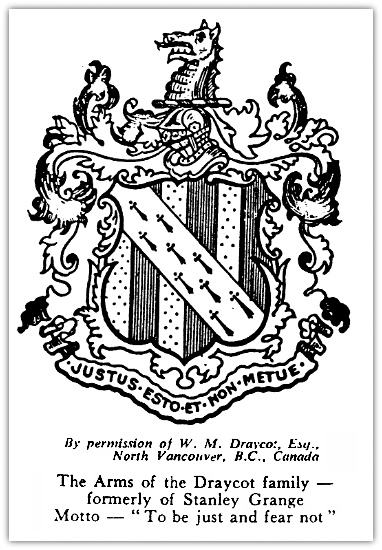 The Church now consists of a Nave and Chancel, the area of the parallelogram being 53 feet by 19 feet, and Dr. Cox in his book "Churches of Derbyshire" gives an accurate resume. Apparently all experts agree that the small round headed priest's doorway, now blocked up, in the south wall, and buttresses at the west end of the Church, are clear examples of Norman work. This leads to the conjecture that the original structure was built in the 12th century. Nearby the priest's doorway is an Early English light, and an ancient piscina almost hidden by the organ. The east window dates from the 13th or 14th centuries, whilst the octagonal stone font is considered to be 14th century.
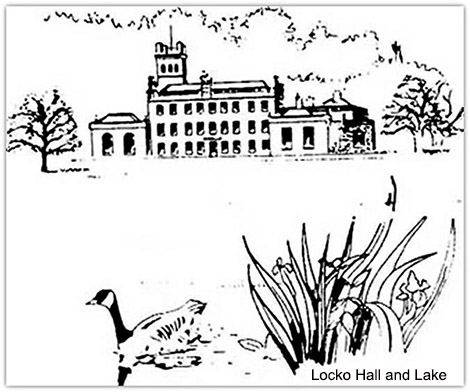 The latest memorial to this family is in the Sanctuary and although of quite recent date is a fine piece of workmanship and design. It is "In loving memory of Frederick Canner, died 1914, and Ethel Canner died 1964". The centre piece is a picture of Stanley Church prior to its restoration, with Stanley Grange Farm, the former family seat, in the background. An apple tree denotes Stanley being in The Appletree Hundred. The sickle, ploughshare, Cat & Fiddle Windmill and sheaf of com depict farming, whilst the colliery winding headgear and the miner's lamp denote the local industry.
 Whilst on the subject of marble tablets according to Bradshaws History Gazetteer and Directory of Derbyshire 1844" one reads in the information given on Stanley Church "One of the marble tablets in the Church is to William Barton, a farmer of Hill Top Farm, a self-taught bone setter and famed over this and adjoining Counties. He performed many cures which the profession had deemed incurable. Died February 1844 aged 88 years". This tablet is now non-existent, most probably removed during the restoration, at which time the Singing Loft at the west end of the Church also disappeared. The painted board attached to the Singing Loft was preserved and now hangs on the north wall in the Choir Stalls. Fourteen names appear on the board with the following inscription, "For these singers was this seat erected, Isaac Rowbottom 1765". The names are; Luke Scattergood, Jno. Swinerton, Wilm. Fletcher, Richd. Richard, Thos. Scattergood, Isaac Rowbottom, Edwd. Williams, Saml. Grundy, Geoe. Williams, Gregy. Barton, Willm. Clark, Humphrey Hart, Thos. Bestwick, Willm. Borebank.
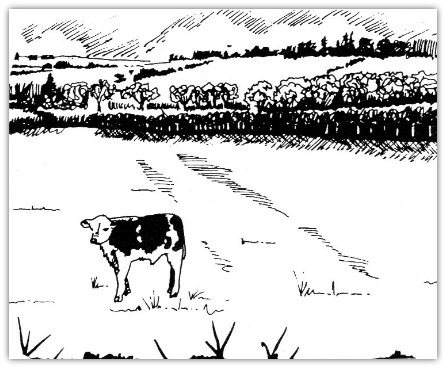 Following opencast coal working and the complete destruction of the old Manor Farm House and buildings in 1959, all traces, if any existed of Stanley Manor, were completely erased for ever. Now a modem farm with up to date methods and buildings graces the land which for centuries contributed to the history of Stanley and Dale Abbey. Records say no traces of Stanley Manor remained even prior to the change of 1959, and the exact spot on which the Manor stood is not known. Portions of the outbuildings demolished in 1959 were of ancient structure, build of soft sandstone, the majority of which was badly affected by erosion from centuries of exposure.