|
Home - The Village Today - History - Maps - Memories - Newspapers - Picture Gallery - World Wars |
|
Home - The Village Today - History - Maps - Memories - Newspapers - Picture Gallery - World Wars |
|
Stanley Stanley Parish and Area History (Page 5) by Terry Hall 2000
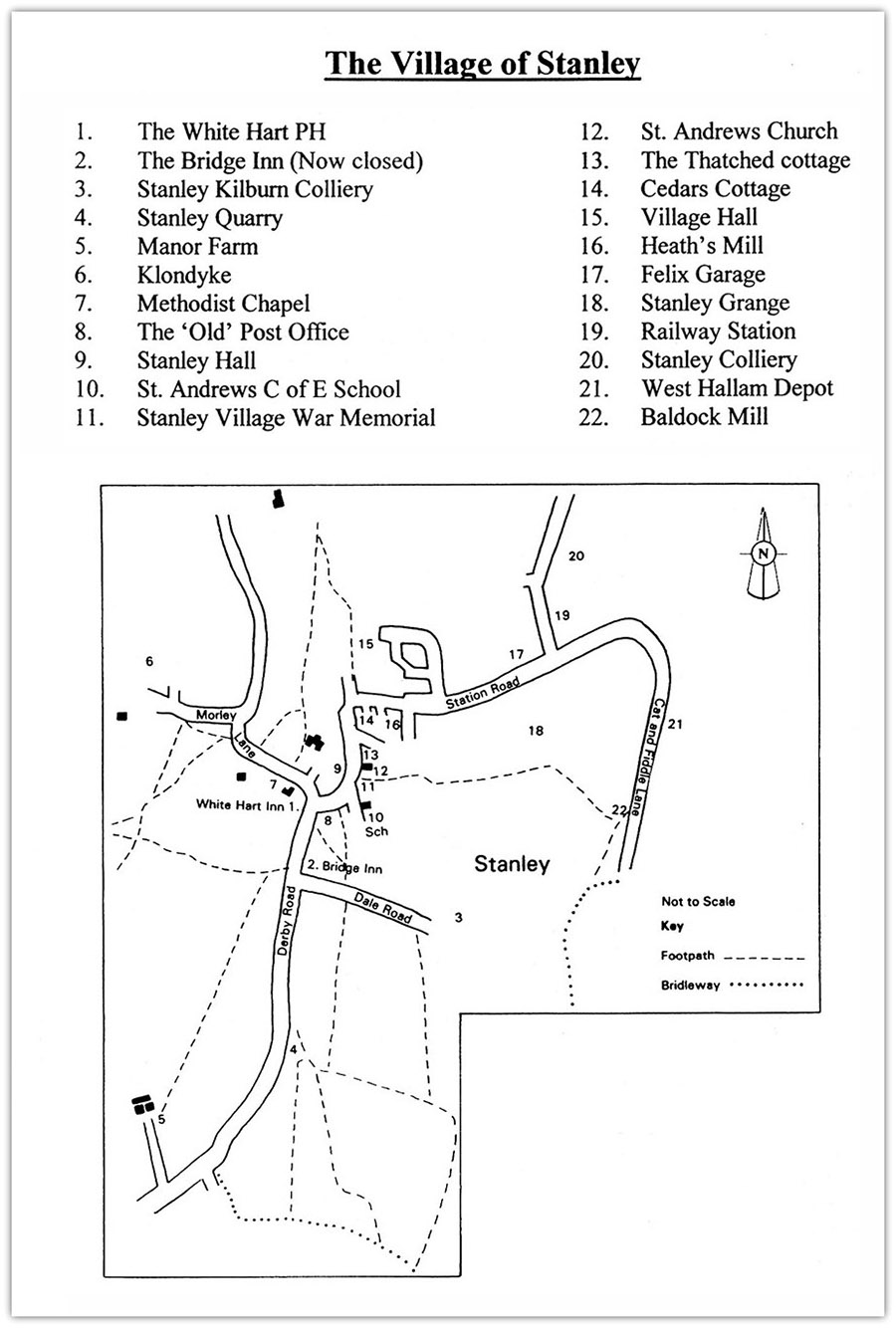
CUSTOMS The wearing of an oak leaf on the 29th May, locally called 'Oak Apple Day', was until a few years ago rigorously upheld by school children in the Village. The wearing of the oak leaf emblem is commonly believed to commemorate the preservation of Charles II, who after the Battle of Worcester in 1651 avoided capture by hiding in an oak tree. Failure to comply with the challenge 'Show your oak’ resulting in a beating by stinging nettles. A Christmas custom, now alas discontinued, was that of the 'guisers' or as known in other parts as the 'Mummers'. 'Letting in the New Year' is still partially observed, when it is considered to be 'good fortune for the Year' if the first person to cross the threshold on New Year's Day be a male, especially if a dark man. If the master of the house be the first to enter the bringing in of bread and a lump of coal assures a good omen for the necessities of life throughout the coming year. COAL MINING Mention has already been made of the Victoria Colliery on Stanley Common, referred to as 'Bread and Herring' Colliery. At Stanley was a drift mine commenced by the Derby Kilburn Colliery Co. Ltd., in 1890. The coal obtained from this Colliery was the celebrated Derby Brights of high calorific value. All coal mined there, other than land sale at the pit head, was transported to 'The Wharf, at Derby, by means of a double track tramway, in trams, hauled from out of the Colliery. These trams of coal were The trams of coal were moved from The Junction to the Wharf at Derby by means of an endless steel rope, the trams being clipped to the moving rope. When installed this was considered to be the longest endless rope in the country. The Wharf was situated at a point opposite Nottingham Road Cemetery, Derby, where the engine house for the plant can still be seen in Hillcrest Road. The only portion of the tramway now visible can be traced in the region of both Morley Lime Lane and Breadsall Lime Lane, where it passed under both roadways. The entire site of The Junction and the tram track to the mine exit were transformed during opencast coal workings in that area, the land now being once again under cultivation. The colliery site has also undergone great changes. The bungalow at the entrance was formerly the Colliery offices, and the buildings a short distance away to the south east were the colliery workshops. The major portion of the colliery tip has been removed and used for road making, mostly on the approach to the new Cavendish Bridge at Shardlow. Timber and pit props for the colliery were carted from West Hallam Station by farmers under contract. During the shaft sinking operations of Stanley Colliery in 1895 an underground spring of sizeable dimensions was struck, approximately 100 yards below the surface. Sinking operations were suspended until adequate pumping arrangements could be introduced and for six months water from the shaft ran across the field upon which the sidings alongside West Hallam Station were later made, and into a brook by the Station platform. When the Colliery came into production use was made of this water. A purifying plant was erected and the water pumped to a reservoir made at Smalley Common, thus providing the water supply for Stanley, Stanley Common, Smalley Common and West Hallam for a number of years. The spring remains constant. Stanley Colliery. Kilburn coal was extensively mined by the Colliery as far afield as Morley Manor and the 'Rose and Crown' at Smalley. Mining subsidence from the workings of the Colliery badly affected Stanley Village property in the 1920's. In addition to the deep mining at Stanley there was also a drift working into the Low Main and the Piper seams. The Colliery provided employment for many of the men of Stanley, but as previously mentioned the coal reserves became exhausted, and the deep mine working of Stanley Colliery ceased in 1959 and the drift mine in 1961. The Derby Kilburn Colliery, often referred to as Stanley Kilburn, had closed some 40 years previously in 1917. following the end of Stanley Colliery soon came the closure of Mapperley Colliery in 1965, and the end of other nearby collieries at Shipley (Woodside and Coppice Collieries), and so coal mining has disappeared from the area. The coal mining has left it's mark on the countryside, and in the graveyard, and will long be remembered in the place names hereabouts which have come from mining terms. We have Balk, Sough and Boreholes as place names in Stanley handed down from generation to generation. Less than half a century ago every resident in Stanley was familiar with these places. Many partook of the pleasant walk to Locko Park by way of The Balk, a footpath running due south from Derby Road and the old quarry. Balk refers to a geological fault, and 'The Balk' could plainly be seen when opencast working was attempted there some years ago. Sough - A dictionary definition gives as a low continuous moaning sound as of wind through an aperture. In lead mining in the Peak of Derbyshire many soughs were made to drain lead mines. On the Ordnance Survey Map for Stanley of 1914, the farm in the area of The Balk was shewn as Sough Farm, and the road as Sough Lane. The farm is now Quarry Farm and the road Dale Road. The fan shaft at the old colliery situated on Sough Lane was in all probability responsible for the name Sough. Boreholes Prior to opencast working it was possible to trace the 'outcrop' or 'basset' of the famous Kilburn seam along the entire ridge to the South of Stanley Village, portions of the seam having been worked over the centuries prior to it becoming compulsory for mining records to be kept. Open cast coal mining between Stanley and Dale Abbey revealed many of the old workings. Hand made tools were found - shovels of heart shaped formation with holly wood for the handle; hollow trees with mortised end used as water pipes or a ventilation shaft, as well as numerous timber supports cut by axe from tree branches prior to the use of a saw. The footpath to Dale Abbey is by way of the Boreholes. It passes 'The Flourish', a local name for the former public house called The Stanhope Arms'. Before leaving the old names mention must be made of that of ’Nibby’ given to Stanley Colliery. The Colliery was originally nicknamed Nibble'em’ by reason of the cuts made in wages in the early days. Later this was abbreviated to 'Nibby' and so it was known as Nibby Colliery right up to the day it closed. STANLEY MILL A prominent landmark visible from most sections of the parish, and its surrounding districts, is 'Cat and Fiddle Windmill', one of the oldest, and thanks to the owners, Stanton and Staveley Co. Ltd., possibly one of the best preserved Post Windmills in the country. This Mill is situated in Dale Abbey parish, but one has only to look at this ancient structure to ascertain the direction of the wind, the Sails must be kept facing the direction of the wind, in order to eliminate the possibility of the Mill being blown over, and the residents at the Millhouse turn the structure by means of windlass at each change of wind direction.
Before the turn of the century, most of the surrounding parishes possessed Windmills, and Mill sites can be seen at West Hallam (Near the Cross roads), at Mapperley (Near the Church), and at Ilkeston (Alongside of Derby Road). Stanley village, being in a valley, as far as can be ascertained never could boast of a Wind mill, but of a Corn Mill, yes, power driven. Known as 'Heath's Mill', this was situated on what is now New Street, which prior to development, was Mill Close, with access road through a gateway alongside 'Stanley House'. The Mill was working until about AD 1890, and shortly after the turn of the century, it was converted into dwelling houses, now Nos. 2 and 4 New Street, but originally known as Mill houses. During recent alterations to this property, grains of wheat were found in apertures between the fourteen inch thick walls.
From observations made in this area, it appears the original brook course was diverted to achieve this constructional feat. The only remaining evidence of this Mill, is the Dam, the partly destroyed overflow system, and the remains of two of the oak baulks which formed the slots for the diversion planks. The four walls of the Mill and the supply watercourse were in evidence during the first decade of the present century. THE RAILWAY STATION In 1876 and 1877 with the Great Northern Railway Extension, a line cut through Stanley east to west virtually severing the whole of Stanley from both West Hallam and Stanley Common. Bridges spanned the line to carry Morley Lane connecting Stanley with Stanley Common and to reach that area of Stanley known as Klondyke off Morley Lane, and again at West Hallam Station to reach West Hallam Village.
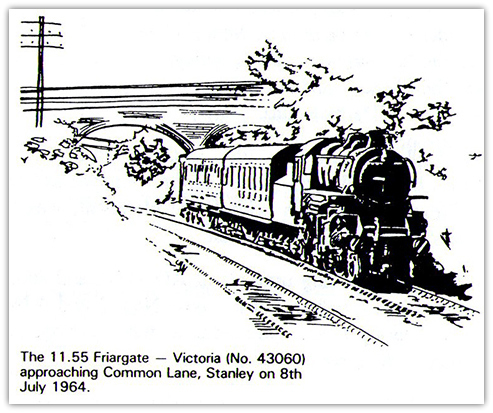
The Station opened early in 1878 and was first called Stanley Station, but this caused great confusion with another Stanley Station in Yorkshire also on the Great Northern Railway, and within a matter of days the name was changed to West Hallam for Dale Abbey, and so it remained until the last day. We learn from Mr Mather's Story of Kimberley of yet another accident which marred the early years of the Station. In Kimberley Cemetery is a memorial provided by the Great Northern Railway Company recording the tragic deaths of Godfrey Bostock, 67, and his wife Mary, 66, of Edgwood Road, Kimberley, who were killed on the 5th October 1884, by an engine at West Hallam Station, they having travelled from Kimberley Station to visit their daughter at West Hallam. Godfrey Bostock was an early employee of Mr R.G. Hanson (Hanson's Kimberley Brewery), and used to deliver beer by horse and cart as far afield as Kegworth. The interment fee in Kimberley Cemetery at that time was 6/-. When the Station was opened at the beginning of 1878 only one track was completed and for a time passenger traffic was operated over this as far as Tutbury. At the turn of the century the Station was dealing with upwards of 90,000 passengers a year, 700 parcels, 6,200 tons goods received and 10,500 tons goods forwarded, with 130 head of livestock received. Coal received had fallen to less than 100 tons a year, no doubt with the advent of Stanley Colliery. The wages of the whole of the staff totalled The Station Master was Mr H.H. Mather. Porter Frank Bull spent most of his working life at the Station and was well known in the villages for miles around. He remained at the Station until he reached his seventies. His great speciality was the signal lamps which were acclaimed to be the brightest on any stretch of the line from Stafford to Grantham Thirty passenger trains called on week days and eight on Sundays, most of them operating between Derby, Nottingham and Grantham Four of the trains went through to Stafford and returned from that point. Seven went to Burton on Trent and returned.
The Depot had an extensive internal railway layout of standard gauge and operated its own passenger service with two coaches. There were two saddle tank steam locomotives of 0-6-0 wheel arrangement. There was also an extensive layout of narrow gauge lines throughout the depot, which dealt with spares of all types for army vehicles. Several hundred people were employed at the Depot during the War. After the War the Depot was finally run down and remained empty for nearly ten years. It is now in use for the storage of cars, cycles, and fertilisers. The Stanley Sidings signal Box was closed and the sidings removed in 1965, and at the same time Spa Bridge was taken down. Spa Bridge was so named by reason of a spring in an adjoining field, the waters of which were considered to be of excellent spa quality, inasmuch as a building was erected at the site, the waters being eagerly sought, until the time when coal extraction underground resulted in the spring disappearing. The author remembers the building, which stood in the field now occupied by the Depot. The Spa Building is marked on the 1914 Edition of the Ordnance Survey Map. The first passenger train to leave West Hallam Station was whistled off by a bone whistle. This whistle was presented by the Great Northern Railway to Mr R, Morris of Grange Farm, West Hallam, the railway having cut right through his farm land. This whistle was used to whistle away the last passenger train which ran on the 5th September, 1964. The Station was finally closed to all traffic in 1966 and the platforms and signal box demolished in 1967. So ends another chapter in the industry associated with Stanley. Before closing the Chapter I must add that the Station dealt with hundreds of thousands of churns of milk all destined for the Great City of London. The Milk Train ran from Stafford to Finsbury Park every day picking up milk from the Staffordshire stations as well as Egginton, Etwall, Mickleover, Breadsall and Derby. The train was known as the Milk Train to the very end, and the side gate leading to West Hallam Station on the Stanley side was always known as the Milk Gate. This was where the farmers carts unloaded the milk. The Milk Train was hauled as far as Colwick by a North Staffordshire Railway locomotive resplendent in crimson livery with gold lettering. Pigeons in their thousands belonging to members of the Stanley Flying Club formed another regular seasonal traffic at the Station. Much traffic passed to and from the Station in connection with local fanning such as brewers grains, seed potatoes, sugar beet, fertilisers and seed wheat. In the last years of the Station hundreds of thousands of cycles were despatched in train loads to the docks for shipment to America. WAR EVENTS
However, a tragic event, not the result of enemy action brought thousands of sightseers to Stanley, following an aircraft crash. During the early evening of Sunday, July 12th, 1942, an aircraft was seen flying at a great height over Stanley, passing over the Village it turned and commenced to climb, when tragedy struck, the tail of the aircraft broke away, the machine going into a spinning power dive. Following three terrific bangs, one can now assume to be the breaking of the sound barrier, the aircraft disintegrated, and amongst the portions falling could be seen a man minus a parachute. The largest portions of the wreckage fell in the Quarry Farm area; all the six occupants were killed. The following day an RAF Spitfire circled the area, and at night a party of soldiers stationed at West Hallam Depot, commenced a search for a missing occupant, eventually found in a cornfield alongside Stanley Hill, it transpired later, the aircraft was an experimental type on trials.
Terry Hall was given full copyright permission to undertake this project by Dulsie Bacon whose husband did the original. My thanks to Sally Taylor for bringing this book to my attention. Elaine
Disclaimer - Copyright - Is this page correct? Something wrong or missing? Please let me know. Also contributions very welcome |


 No Christmas was complete without a band of locals in costume appearing at a family party. The Leader opening the door of the selected house with the words "I open the door, I enter in, I hope you favour I will win, etc.," followed by the company to give their performance.
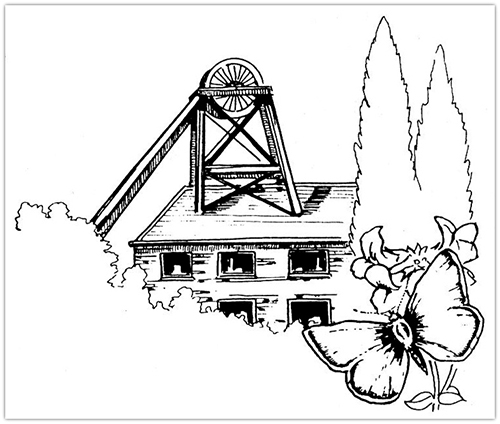 taken down an incline, to what was known as 'The Junction', situated alongside the Old Great Northern Railway, where a further drift mine was made about 1912.
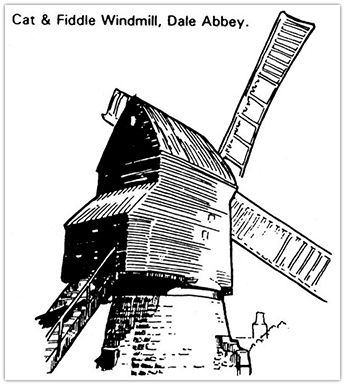 Many times has the writer been inside the Mill when the Sails were in motion, the old timbers creaking, and the Miller, the late Mr George Smedley busily tending to the duties of corn grinding. Although the Mill is maintained in working condition, the Sails are seldom seen revolving with the wind these days.
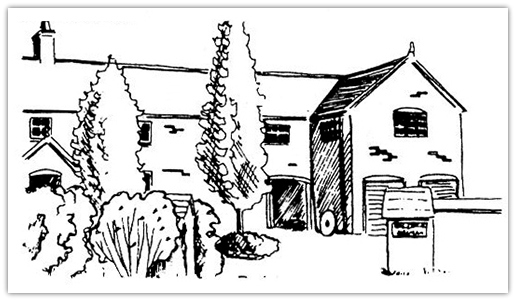 A Water Mill, which was built by the Lay Canons of Dale Abbey, known as Baldock Mill, actually in Dale Abbey parish, obtained its supply of water from Stanley parish, via Stanley Brook. A canal or channel had been constructed to divert a supply of water to the Mill Dam, regulated by means of planks placed into prepared slots, alongside a footbridge, and a skillfully constructed overflow system at the approach to the Dam.
 Whilst contractors were building the line through Stanley between the Station and Morley Lane tragedy struck. A wagon of rails ran away down the incline through the Station and became derailed opposite Grange Farm, West Hallam belonging to Richard Morris. It is related that when the wagon came off the track the rails flew in all directions like a shower of arrows. One struck a workman severing both legs. Hidden in the water butt alongside the platelayers cabin tied to a piece of string was a bottle of whiskey, and this was administered to the unfortunate man to deaden the pain. The cabin still stands to the west of the Station Bridge and is actually in the Parish of Stanley, a small stream running along the bridge approach towards Grange Farm, Stanley marking the boundary. The author can well remember the injured man whose legs were severed almost to the buttocks sitting on a trolley of sorts (boards to which four small wheels were attached) outside the Great Northern Railway Station, on Heanor Road, Ilkeston, begging from the many passers-by, especially the railway passengers. Ilkeston Station was then very busy. The fellow wore gloves and propelled himself along with his hands.
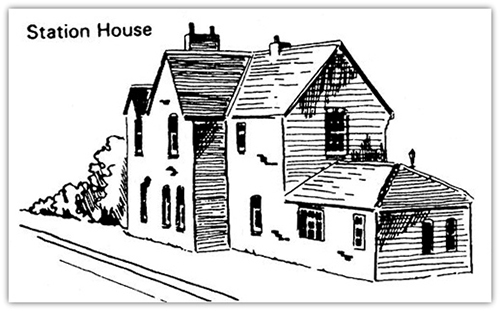 to less than £500 a year. In 1923 the Great Northern Railway was amalgamated with the London and North Eastern Railway, and about that time the Station had installed its own gas plant. The gas oil came from Cleethorpes, the only other station where the LNER Railway had a gas plant. Gaslighting was extended to the platforms, waiting rooms and the station master's house. Gas oil flowed through the pipes like black treacle. After some years of operation the plant came to an untimely end. Porter Frank Bull had put the plant in operation one evening. To do this a gas ring was lit in the plant house presumably to warm up the oil. Frank then departed on his daily errand to fetch the Station Master's milk from Mr. Morris at Grange Farm, West Hallam. During his absence the plant blew up, and the Station reverted to oil lighting which remained on the platforms until the Station finally closed in 1964 to passenger traffic. Electric light was installed in the Booking Office and Waiting Rooms on the Stanley side in 1943. This was because of the increased business created on the opening of the West Hallam Ordnance Depot, five clerks were then employed in the Booking Office.
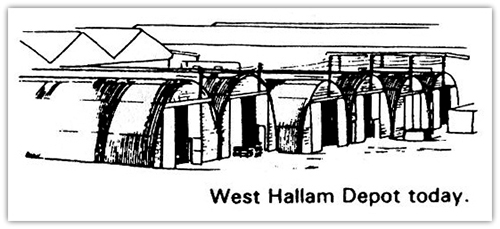 Shortly after the Second World War commenced the West Hallam Ordnance Depot was built on the land of Mr R. Morris of Grange Farm, West Hallam This was connected to the main line by the Royal Engineers in the vicinity of Spa bridge which passed over the railway giving Mr Morris the necessary access to his farmland. At this point a signal box was erected and this was called Stanley Siding box. So once more Stanley came into the local railway nomenclature.
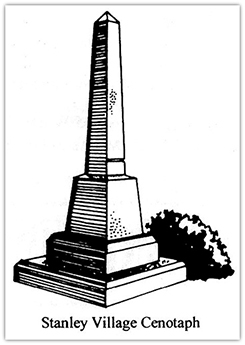 Stanley in keeping with other Villages, made it's contribution to World War II, in both men and materials and fortunately no bombs actually fell in the Parish.