|
Home - The Village Today - History - Maps - Memories - Newspapers - Picture Gallery - World Wars |
|
Home - The Village Today - History - Maps - Memories - Newspapers - Picture Gallery - World Wars |
FOR THE TECHNICALLY MINDED Aircraft data: - Vickers Armstrongs Wellington Mk.VI (Type 431) A total of almost 11,500 Wellingtons of various marks were produced, mainly for use in the RAF’s medium bomber role in which they carried a bomb load of about 4500lb. The Wellington first flew in June 1936 and the type entered squadron service in 1938, finally being retired in 1953. The various marks were powered by a range of engines including Bristol Pegasus & Hercules, Rolls-Royce Merlin and Pratt & Whitney Twin Wasp. The Mks. V & VI were intended for a high-altitude bomber force. The design of these aircraft replaced the standard forward fuselage structure with a bullet-shaped cabin 18ft 3in long and 5ft 5in diameter, entered by a 3ft 2in circular hatch at the rear, and pressurised to 7.5lb/sq.in by blowers fitted to the engines. The standard, unpressurised, rear four-gun turret was retained for defence. With problems outweighing advantages by the time it was ready for service, only 67 were produced, three with Hercules engines, the remaining 29 of the Mk V order were built as Mk VI A’s with Merlin engines. The Mk.V was fitted with Hercules VIII engines, and the Mk.VI, of which W5795 was the prototype, utilised the Merlin 60, with the Merlin 62 being use on later aircraft.
© Peter Kirk Derbyshire Historical Aviation Society
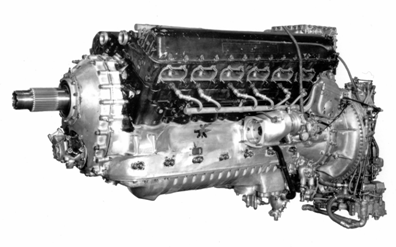
ENGINE DATA Rolls-Royce Merlin Mk.60 - Over 168,000 Merlins were produced between 1935 and 1951 and served in a wide variety of military and civil aircraft types, notably Spitfire, Hurricane, Mustang, Lancaster and York. The Mk.60 featured a two-speed, two-stage supercharger. It was to power the Vickers Armstrongs Wellington Mk.VI pressurised bomber and to this end was fitted with a cabin blower to provide the pressurisation. A total of 75 were built at Derby between June 1941 and March 1942. The Mk.62 used in the later aircraft was similar but had separate cylinder blocks and heads in place of the earlier one-piece blocks.
Engines 68231/A2546047 and 68505/A278450 were installed in Wellington VI W5795 that crashed at Stanley Village, Derbyshire
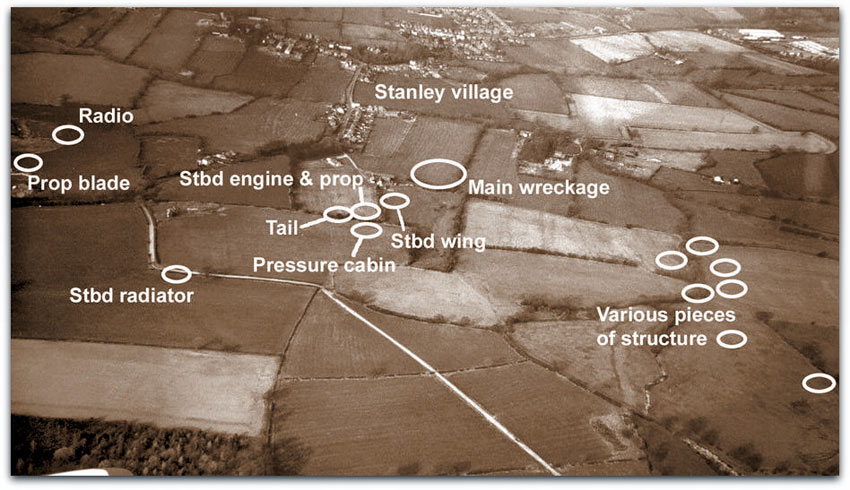
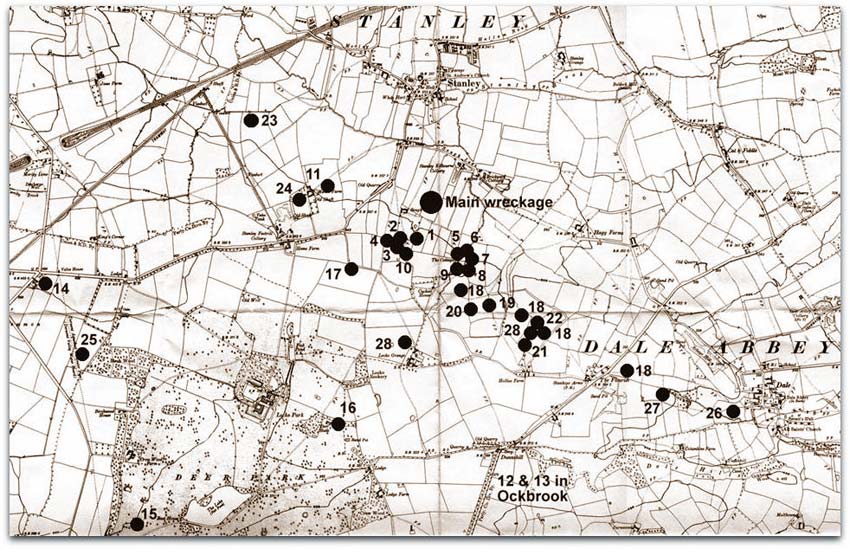
© Peter Kirk Derbyshire Historical Aviation Society Wreckage Plot
KEY TO MAP OF WRECKAGE PLOT Main Wreckage
© Peter Kirk Bernard Walters our St Andrew’s Churchwarden wrote he remembered this tragic event very well. It was a very pleasant evening and I was in company with my parents and grandparents. We were walking along a footpath bordering the parishes of Dale and Stanley, we became aware of an aircraft in the vicinity, obviously in distress, as it was making a most unusual sound, a few seconds later we were horrified to see the aircraft flying very low, just yards from us down the next field to the one we were in.

Disclaimer - Copyright - Is this page correct? Something wrong or missing? Please let me know. Also contributions very welcome |
||||||||||||||||||||||||||||||||||||||||||||||||||||||||||||||||||||||||||||||||||||||||||||||||||||||||||||