|
Home - The Village Today - History - Maps - Memories - Newspapers - Picture Gallery - World Wars |
|
Home - The Village Today - History - Maps - Memories - Newspapers - Picture Gallery - World Wars |
This extract is taken from a book called ‘Wellington, The Geodetic Giant’ (September 1989) by Martin Bowman and contains a picture of Wellington Mk VI W5795 captioned ‘Dived into the ground from high-altitude four miles north-east of Derby on 12 July 1942’ (Copyright RAF Museum). The book has pages missing including the details of the Printers and any infringement of copyright is regretted Squadron Leader Bufton of 109 Sqn flew a Wellington Mk6 (W5901) with the following recollection. ‘Flying in the Mk VI was quite an experience in itself. It had a pressure chamber up forward, resembling a large boiler about five feet in diameter with a large valve at the front which had to be closed after the pilot, navigator and wireless operator (no gunner, naturally) had squeezed in through a just-large-enough, if we bent double, circular “door” which had to be clamped closed with four very large and solid steel clips. Finally, a large wheel in the centre of the locking contraption had to be turned many times to close the main valve and so make the chamber airtight. Then pressure could be built up to a comfortable level. There was also a low cupola above the pilot’s head out of which he only could just see – when the tail was down, so that taxying was a rather “hit or miss” affair. Getting out of the contraption in a hurry was seldom performed in less than 1 ½ minutes; then there was a forty-foot trot to the rear exit’ - hardly calculated to give one confidence in survival if the worst happened!
THE TEST FLIGHT THAT FAILED OVER STANLEY Over the years there has been much conjecture about the circumstances of the Wellington crash at Stanley on Sunday evening, 12 July 1942. Now sixty years on I hope to put the record straight and tell the true story. It is necessary to go back to 1938 when the idea of a high-altitude bomber, which could operate above the ceiling of enemy fighters, was put forward. The specification required an aircraft capable of operating at 40,000ft¾an extremely strenuous demand for those days. Vickers Armstrongs was asked to investigate the possibilities of using the Wellington airframe for the purpose and in May 1939 an order was given for two prototype modified Mk1 aircraft to be fitted with Bristol Hercules engines. The Hercules-powered aircraft did not come up to expectations, so Vickers concentrated on using Rolls-Royce Merlin engines, which was to become the Wellington Mk.VI.
A four gun replaced the two-gun rear turret of the standard Wellington, which meant that the unfortunate gunner was exposed to temperatures as low as -70ºC, at which his heated flying suit was hardly adequate. Plans to install a pressurised rear turret never came to fruition. Testing at the designed heights brought to light many unexpected problems. The outside temperature was at least -40ºC and the main flying controls and trimmer circuits became immovable due to the freezing of the grease in the hinge bearings and special hydraulic fluid had to be used to enable operation of the rear turret and bomb doors. On one occasion the fuselage was badly damaged when oil from a leak froze into lumps as it was hurled off the propeller. The dome, windows and entrance hatch constantly iced up because of high humidity in the cabin. Drying the air cured this, but caused much discomfort to the crew. Icing outside the cabin made emergency escape practically impossible and sometimes the crew took ten minutes to depressurise and open the hatch. Emergency escape facilities were introduced on later production aircraft as a direct result of this accident. Note: Only three Mk V aircraft were built, the two prototypes and one production aircraft the remainder were converted to Mk VI. The Stanley Wellington had the serial number W5795 and was built as the prototype Mk VI at Vickers' Foxwarren factory near Cobham in Surrey. It was fitted with two Merlin 60 engine turning Rotol Jablo four-bladed propellers and was passed to the experimental station at Boscombe Down for performance trial at 25,000 lbs A.U.W. Even with the Merlin 60 the aircraft was hard-pressed to reach its specified altitude and in order to achieve it W5795 was at one stage fitted with six-foot extensions to each of the wings. Freeze-up problems had not been solved and burnt oil fumes from the cabin compressor were sometimes so thick that the pilot couldn't see his instruments. The constant speed props tended to run away out of control at these low temperatures. Work to solve the problems continued throughout 1941, and was later of great value in the design of other high altitude aircraft. Now back to the events of 12 July. During the late afternoon Squadron Leader Cyril Colmore and his crew, Sergeant Arthur Smith, navigator, Sergeant Ron Gillot, wireless operator, Pilot Officer Ken Radford, air gunner, and Mr Clifford Abbott, civilian flight test observer, were briefed for a high-altitude test flight followed by all-out speed checks at various heights. They took of from Boscombe Down at 1830 hours, and for the next hour radio messages were received from the Wellington to the effect that the tests were going well. W5795 was seen by a Derby anti-aircraft battery and plotted flying in a northeasterly direction at 32,000ft making vapour trails. Suddenly the aircraft was seen to enter a high-speed dive and after a few seconds the whole aircraft broke up, the pressure cabin separating from the fuselage. Wreckage fell over a wide area from Ockbrook to the railway at Stanley Common at about 1941hrs. The crew had no chance of escape. The bodies of Sqn.Ldr Colmore, Sgt.Smith and Sgt.Gillot were found in the remains of the pressure cabin. Mr.Abbott whose work station was outside of the pressure cabin forward of the main spar had been thrown out and was found close to the wreckage. Pilot Officer Radford was unable to reach his parachute, which was stored in the fuselage just beyond his turret doors. He was thrown out of the turret when the tail section parted from the rest of the fuselage. His body was later recovered from a cornfield some distance from the wrecked turret. After a study of the wreckage, the accident investigators came to the following conclusions. The Wellington had climbed to a height of 35,500ft and had levelled off to carry out a speed check when a vibration developed in the starboard engine. A section of No 4 propeller blade penetrated the cabin causing an explosive decompression of the capsule and a resulting lack of oxygen. Sqn/Ldr Colmore throttled the engine back, wound on full right rudder trim to counter the swing and commenced a descent to destruction. Parts of the aircraft were found between Ockbrook and the railway line just outside Stanley. Most poignant was that Colmore’s handkerchief was found near Dale Abbey, and identified by its monogram. I believe the White Hart pub was used as a temporary mortuary for the crew. A central area was set up for wreckage collection before transportation to Boscombe Down for detailed inspection. Some years ago I was given a fuel contents gauge which is reputed to have come from the crashsite. Perhaps it is the only part remaining from the aircraft? Between 60 and 70 Mk.VI Wellingtons were produced, but by the time they had reached operational status, the faster and simpler Mosquito was already carrying out the same task without the problems of the pressure cabin, and enemy fighters were also operating at high altitude. The nearest that the high-altitude Wellingtons came to operational use, was when a few were issued to 109 Squadron for a short period in 1941 for trials with ‘Oboe’ radar. Most of the aircraft were scrapped by 1943. My thanks to the late Peter Ward of Hilton who carried out the early research on the events of 12 July 1942. © Peter Felix

Disclaimer - Copyright - Is this page correct? Something wrong or missing? Please let me know. Also contributions very welcome |



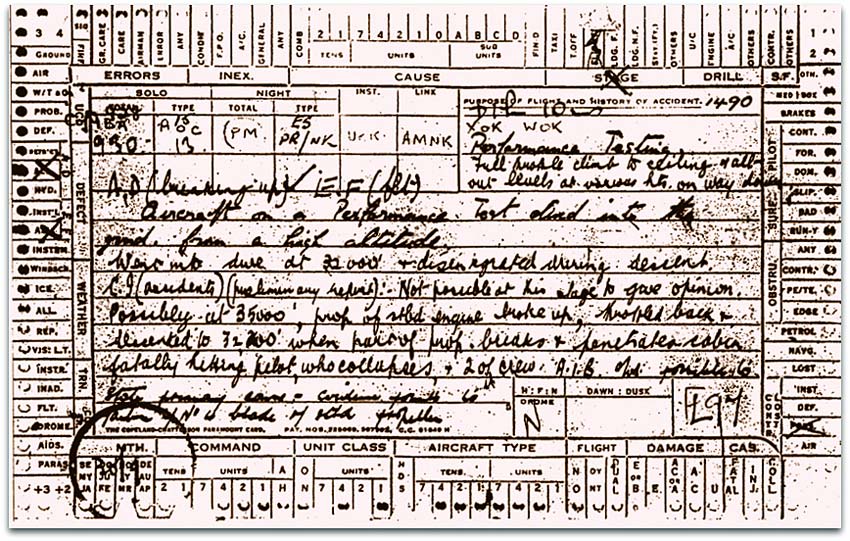
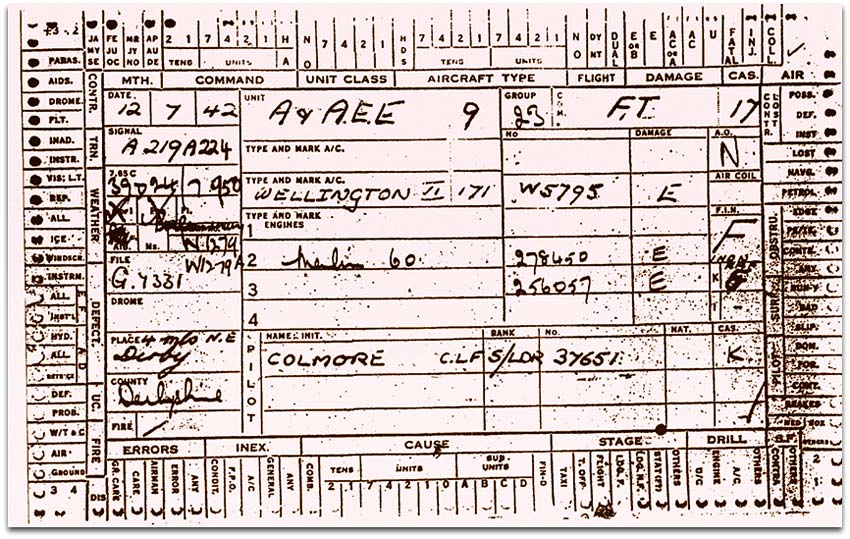
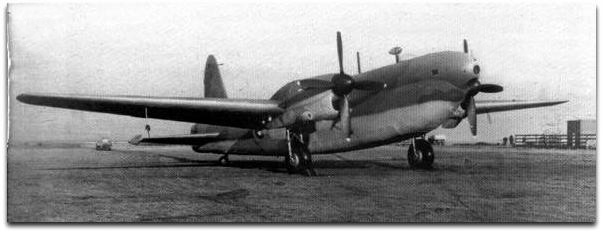
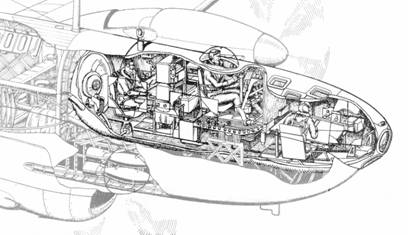 The nose of the Wellington’s geodetic fuselage structure was modified to carry a pressure cabin as shown in the diagram. The bomb-shaped cabin was a metal shell internally lagged with heat and sound-insulating material and accommodated the pilot, navigator-bomb-aimer, and wireless operator. Entry was from the fuselage through a hatch at the tail-end of the pressure cabin. The pilot sat with his head in a perspex dome and observation windows were provided for the other crewmembers. Compressors driven by the two Merlin 60 engines supplied air to keep the pressure in the cabin equivalent to that at 10,000 feet. This air also provided heat to the cabin. Oxygen was available for an emergency cabin pressure